1. Arithmetic operators
|
Operator |
Meaning |
Example |
Result |
|---|---|---|---|
|
|
Add |
|
9 |
|
|
Subtract |
|
5 |
|
|
Multiply |
|
14 |
|
|
Divide |
|
3 (not 3.5!) |
|
|
Remainder (modulus) |
|
1 |
Integer division: the number-one surprise
When both sides of / are whole numbers, Java does integer division and throws away the decimal part:
public class Main { public static void main(String[] args) { System.out.println(7 / 2); // 3 System.out.println(7.0 / 2); // 3.5 System.out.println(7 / 2.0); // 3.5 System.out.println(1 / 3); // 0 int total = 250, count = 3; double avg = total / count; // 83.0 (division happened in int first!) System.out.println(avg); }}The remainder operator %
% gives what is left over after division. It is surprisingly useful:
-
n % 2 == 0means n is even. -
n % 10gives the last digit of n (1234 % 10is 4). -
n / 10removes the last digit (1234 / 10is 123). -
minutes % 60gives leftover minutes after taking out full hours.
These two tricks (% 10 and / 10) are the key to many problems in Session 10.
Dividing by zero
-
10 / 0with ints crashes the program withArithmeticException: / by zero. -
10.0 / 0with doubles givesInfinity(no crash).
2. Assignment and compound assignment
int x = 10;x += 5; // same as x = x + 5 → 15x -= 3; // x = x - 3 → 12x *= 2; // x = x * 2 → 24x /= 5; // x = x / 5 → 4x %= 3; // x = x % 3 → 13. Increment and decrement: ++ and --
x++ adds 1 to x. x-- subtracts 1. There are two forms, and the difference matters when the expression is used inside another expression:
-
Post-increment
x++: use the current value first, then add 1. -
Pre-increment
++x: add 1 first, then use the new value.
public class Main { public static void main(String[] args) { int a = 5; int b = a++; // b gets 5, then a becomes 6 System.out.println(a + " " + b); // 6 5 int c = 5; int d = ++c; // c becomes 6, then d gets 6 System.out.println(c + " " + d); // 6 6 }}The classic interview puzzle. Dry-run it together on paper:
int a = 5;int b = a++ + ++a;|
Step |
What happens |
Value used |
a after |
|---|---|---|---|
|
1 |
|
5 |
6 |
|
2 |
|
7 |
7 |
|
3 |
|
Result: a = 7, b = 12. In real code, never write expressions like this; they're for testing understanding only.
4. Relational (comparison) operators
These compare two values and always produce a boolean (true or false):
|
Operator |
Meaning |
Example |
Result |
|---|---|---|---|
|
|
equal to |
|
true |
|
|
not equal to |
|
true |
|
|
greater / less than |
|
true |
|
|
greater / less than or equal |
|
true |
Common mistakes
= assigns; == compares. if (x = 5) is a bug (in Java it's a compile error for ints, luckily). Say it aloud: "= is gets, == is equals."
5. Logical operators
Combine conditions:
|
Operator |
Name |
True when |
|---|---|---|
|
|
AND |
both sides are true |
|
|
OR |
at least one side is true |
|
|
NOT |
flips true ↔ false |
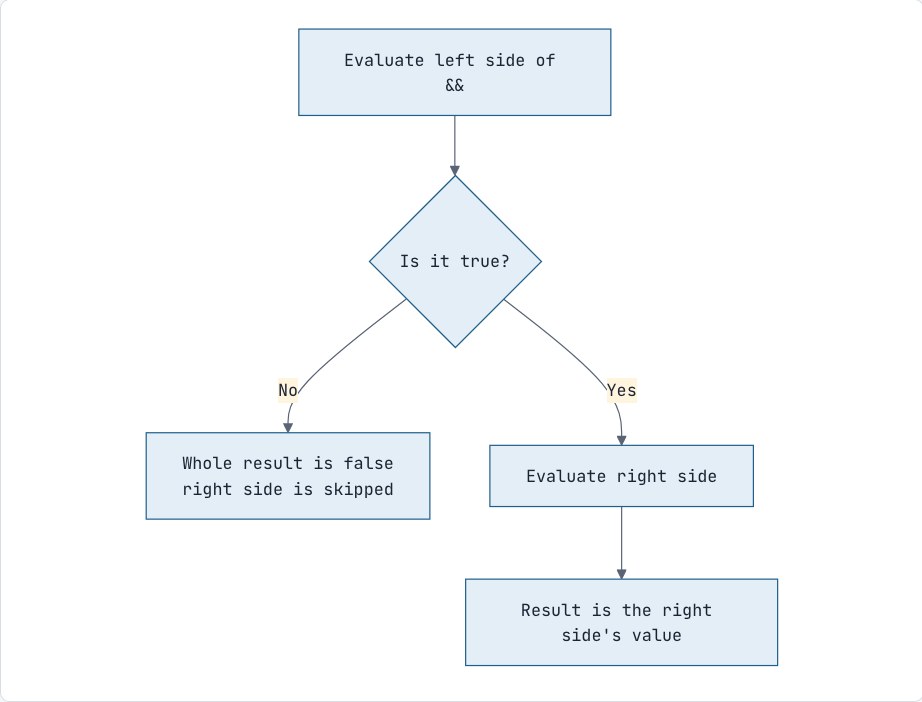
public class Main { public static void main(String[] args) { int age = 20; boolean hasId = true; System.out.println(age >= 18 && hasId); // true System.out.println(age < 13 || age > 60); // false System.out.println(!hasId); // false }}Short-circuiting: && stops as soon as the left side is false (the answer can only be false). || stops as soon as the left side is true. This lets you write safe checks like count != 0 && total / count > 50, where the division never runs when count is 0.
6. + with text and numbers
Java evaluates + left to right. Once text is involved, everything after it becomes text joining:
public class Main { public static void main(String[] args) { System.out.println("Sum: " + 5 + 3); // Sum: 53 System.out.println("Sum: " + (5 + 3)); // Sum: 8 System.out.println(5 + 3 + " is sum"); // 8 is sum System.out.println('A' + 1); // 66 (char is a number underneath) }}7. Order of evaluation (precedence)
Just like BODMAS in school: *, /, % happen before + and -. Simplified order, from highest to lowest:
-
Brackets
( ) -
++,--,! -
*,/,% -
+,- -
<,>,<=,>= -
==,!= -
&& -
|| -
=,+=and the other assignments
Professional rule: when in doubt, use brackets. (a + b) * c is clearer than relying on memory.
📝 Note: Bitwise operators
Java also has bitwise operators (
&,|,^,~,<<,>>) that work on individual bits. They're rarely needed in everyday code. Mention that they exist and move on.
Interview questions
What is the output of System.out.println(10 / 4); and why?
2. Both operands are int, so Java performs integer division and discards the fractional part.
What is the difference between i++ and ++i?
Both increment i by 1. i++ evaluates to the old value; ++i evaluates to the new value. The difference only matters when the result is used within a larger expression.
What is short-circuit evaluation?
With && and ||, the right operand is evaluated only if needed. false && x never evaluates x; true || x never evaluates x.
Practice
-
easy Given
int totalSeconds = 3725;, print hours, minutes and seconds (answer: 1 h 2 m 5 s). -
easy Given a 3-digit number like 472, print its last digit, first digit and middle digit using only
/and%. -
easy Calculate simple interest
P * R * T / 100for P = 50000, R = 7.5, T = 3. -
medium Swap two
intvariables using a third variable. Then do it without a third variable. -
medium Predict each output, then check:
int x = 3;System.out.println(x++ * 2);System.out.println(x);System.out.println(--x + x++);System.out.println(x);-
medium Write a boolean expression that is true when
yearis a leap year: divisible by 4 and not by 100, or divisible by 400.
Problem 1
int totalSeconds = 3725;int hours = totalSeconds / 3600;int minutes = (totalSeconds % 3600) / 60;int seconds = totalSeconds % 60;System.out.println(hours + " h " + minutes + " m " + seconds + " s");Problem 2
public class Digits { public static void main(String[] args) { int n = 472; int last = n % 10; // 472 % 10 = 2 int first = n / 100; // 472 / 100 = 4 (integer division drops .72) int middle = (n / 10) % 10; // 472 / 10 = 47, then 47 % 10 = 7 System.out.println("Last: " + last); System.out.println("First: " + first); System.out.println("Middle: " + middle); }}Output
Last: 2First: 4Middle: 7The two tools: % 10 picks the last digit, / 10 removes the last digit. Every digit problem in Session 10 is a combination of these two moves.
Problem 3
public class SimpleInterest { public static void main(String[] args) { double p = 50000; double r = 7.5; int t = 3; double si = p * r * t / 100; System.out.println("Simple interest: " + si); System.out.println("Total amount: " + (p + si)); }}Output
Simple interest: 11250.0Total amount: 61250.0Because p and r are double, the whole calculation happens in decimals. If all three were int (and R were a whole number), P * R * T / 100 could lose the decimal part through integer division. Note the brackets in (p + si): without them, "Total amount: " + p + si would join the two numbers as text (Session 4, section 6).
Problem 4
// With a temp variableint a = 5, b = 9;int temp = a;a = b;b = temp;// Without a temp variablea = a + b; // a = 14b = a - b; // b = 14 - 9 = 5a = a - b; // a = 14 - 5 = 9Problem 5
6 (uses 3, then x becomes 4), then 4, then 6 (--x makes x 3 and uses 3; x++ uses 3 and makes x 4; 3 + 3 = 6), then 4.
Problem 6
boolean isLeap = (year % 4 == 0 && year % 100 != 0) || (year % 400 == 0);
Discussion